

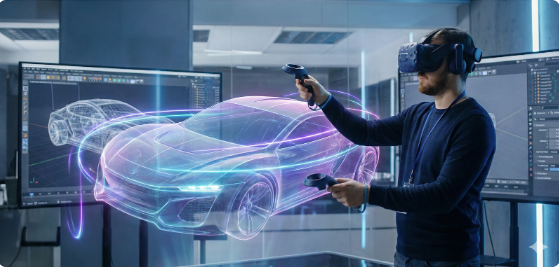
Technology has always been changing with design. Since the emergence of hand-drawn sketches through to computer-aided design, every new change has altered the manner in which ideas are formulated and manifested.
VR 3D modeling is currently making the next big leap, altering the nature of what designers are producing, in addition to the way. Virtual reality is transforming how creators, teams, and businesses in different sectors collaborate, work, and create by placing them within their environment.
From Screens to Immersive Creation
Conventional 3D modeling occurs on a flat screen where a mouse and a keyboard are used to perceive the three-dimensional space through a two-dimensional interface. This is a great technique, but it may prevent spatial perception and creativity.
VR 3D modelling can eliminate this wall and place the designer in the virtual world. Designers do not visualize depth and scale; they get to experience them directly. This change allows the natural and intuitive design process, such that ideas can be molded as though they were real objects.
Improving the Spatial Awareness and Scale
Among the largest transformations VR will have on design, better spatial awareness can be distinguished. With virtual reality, designers are able to see their models in full scale and can also walk around their models and test proportions in real-time.
This is especially useful in architecture, interior design, and product development, where scale is very important. VR 3D modeling can enable designers to identify problems in space at an early stage, limit errors, and work on the project later. VR has been incorporated in many 3D modeling services to increase the level of accuracy and certainty in design choices.
Accelerating Concept Development
Ideation in the initial stages might involve fast testing of several ideas. VR allows designers to draw, carve, and manipulate models in a real-time environment.
Using VR 3D modeling, the designer can:
- Be inventive with shapes and design.
- Real-time visualization of modifications.
- Alternate among design alternatives fast.
- Cull ideas without losing the creative energy.
The speed of this rapid iteration enables creativity to thrive, with projects being on time.
Redefining Collaboration and Feedback
Design is not often an individual undertaking. A final result is formed with the help of teams, clients, and even stakeholders. VR is changing teamwork through the development of virtual design studios.
In a VR environment, several people can use one model, discuss the changes, and give feedback simultaneously. This renders VR 3D modeling a strong communication method to decrease the misunderstandings, which tend to occur with the help of fixed illustrations or screenshots. Consequently, 3D modeling services are starting to provide VR-based collaboration as a feature.
Making Design More Inclusive and Accessible
Not every stakeholder is at ease with screens and technical drawings or 3D models. VR fills this gap by ensuring design experiences are more intuitive.
Clients and those who are not technical can easily walk into the design and comprehend the relationship of the space, as well as give their input without fear. This inclusiveness enhances the level of participation and also results in better-informed decisions during the design process.
Reducing Costs and Design Risks
Mistakes in design may appear at the end of a project at a high cost. VR enables designers to test functionality, flow, and usability early, when changes can be made more easily and less costly to make.
Working with VR 3D modeling, the designers will be able to:
- Find defects in design before production.
- Keep the revisions to a minimum at the later stages.
- Reduce overall project risk
This progressive strategy is among the reasons why progressive 3D modeling services are spending large amounts of money on VR functionalities.
Supporting Creative Confidence and Innovation
Designing in VR also provides designers with the sensation of being present and in control, which, with traditional tools, is not always the case. The fact that one is surrounded by the design promotes experimentation and daring thoughts.
Designers are able to experiment with unorthodox ideas without fearing that they can make changes immediately or revert the changes. Such liberty encourages innovation and challenges the realms of the creative mind, which eventually results in the creation of better and more unique designs.
Integrating with Existing Design Workflows
Although VR is game-changing, it does not mean that it replaces traditional tools completely. Instead, it complements them. VR is a conceptualization and space assessment tool used by many designers, which is refined by traditional modeling programs.
Contemporary 3D modeling services provide hybrid workflows that are smooth and merge VR with the current pipelines, as well as remain efficient and do not interfere with the conventional processes.
The Future of Designer-Centered Creation
Adoption will keep on rising as the VR hardware is more affordable and the software is more developed. The creative capabilities will be expanded with the help of AI-based modeling, haptic feedback, and cloud-based VR and other new developments.
3D modeling in VR is not a new technology; it is a change of paradigm both in the way designers think, create, and collaborate.
Conclusion
The VR 3D modeling is revolutionizing the design process as it makes the design process more enjoyable, experiential, and interactive. VR enables designers to think more productively and creatively by enhancing their ability to gain a better sense of space and speed up the design process, and eliminate design risks.
With a rising demand in the 3D modeling world, the usage of VR to create 3D models will make it to the forefront of designing the future of design, one in which creativity is not screen-bound; it is as if it will be experienced internally.
