

Whether you are drawn by the golden silence of the Sahara, the storied medinas of Fez and Marrakech, or the snowcapped peaks of the Atlas Mountains, tours to Morocco promise an encounter with a world unlike any other — ancient, luminous, and endlessly surprising.
Tours to Morocco
Morocco has long occupied a singular place in the imagination of travelers. Positioned at the crossroads of Africa, Europe, and the Arab world, it is a kingdom of extraordinary contradictions — where Roman ruins stand within walking distance of medieval mosques, where nomadic Berber traditions survive alongside cosmopolitan café culture, and where the Atlantic coast gives way, within a few hours’ drive, to one of the world’s great desert wildernesses. Tours to Morocco offer the surest path into the heart of this complexity, providing the structure, expertise, and local knowledge needed to navigate a country that richly rewards depth over speed.
For those considering tours to Morocco for the first time, the choice of itinerary can feel daunting. The country is larger than it appears on a map, its regions are vastly different in character, and the possibilities — from desert expeditions and mountain treks to culinary journeys and architectural pilgrimages — are seemingly without limit. This guide sets out the essentials: the landscapes, the cities, the culture, and the practical wisdom that will help you choose the tour best suited to your own vision of Morocco.
Why Choose a Tour to Morocco?
Independent travel in Morocco is entirely possible, but tours to Morocco offer advantages that independent itineraries rarely match. The country’s medinas — the ancient walled city centers of Fez, Marrakech, Meknès, and Chefchaouen — are deliberately labyrinthine, designed in centuries past to confuse invaders and preserve community privacy. For the uninitiated traveler, they can feel impenetrable. An experienced guide does not merely point the way; they open doors — literally and figuratively — to a world that keeps its finest experiences out of plain sight.
Language, too, presents a consideration. Morocco’s official languages are Arabic and Amazigh (Tamazight), with French widely spoken in professional and urban contexts and Spanish prevalent in the north. A knowledgeable tour guide bridges these linguistic worlds effortlessly, transforming transactions into conversations and strangers into hosts.
“The finest tours to Morocco do not deliver the country to you. They introduce you to it — slowly, respectfully, and with the kind of detail that no guidebook can fully capture.”
The Essential Destinations
Any serious tour to Morocco will anchor itself around the country’s most storied cities and landscapes. Fez, founded in the 9th century, is perhaps the most intact medieval city on earth. Its medina — a UNESCO World Heritage Site since 1981 — contains over 9,000 streets, the world’s oldest functioning university (the University of al-Qarawiyyin, established in 859 AD), and artisan workshops producing leather, ceramics, and brass using techniques unchanged for a thousand years.
Marrakech provides an entirely different energy: theatrical, sensual, and immediately seductive. The Djemaa el-Fna square is one of the great public stages of the world, transforming hourly from a morning market into an evening carnival of musicians, storytellers, and food vendors. The city’s palaces — the Bahia, the El Badi — and its extraordinary Saadian Tombs speak to a history of imperial ambition and refined aesthetic achievement that rivals any court in the Mediterranean world.
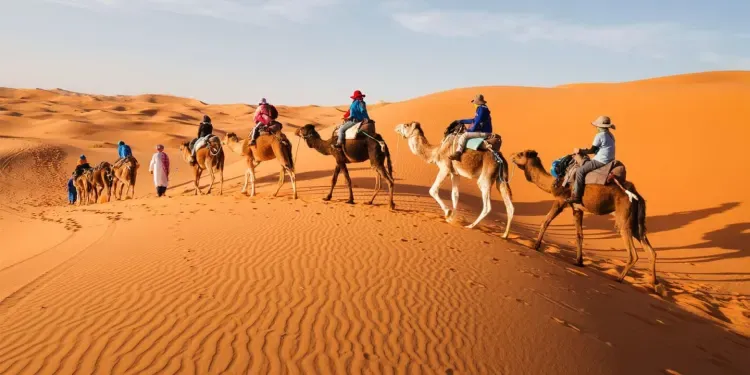
Beyond the cities, tours to Morocco venture south through the Draa Valley, past painted kasbahs and palmeries, toward the Sahara’s edge at Merzouga. The dunes of Erg Chebbi — some rising 150 meters above the desert floor — are among the most photographed natural formations in Africa, and rightly so. Their colors shift with the light in a way that no camera fully renders: rose at dawn, copper at noon, deep amber at the hour before sunset when the shadows grow long and the silence becomes almost physical.
Types of Tours to Morocco
Group Tours
Sociable, cost-effective, and expertly guided — ideal for solo travelers and those who enjoy shared discovery.
Private Tours
Fully bespoke itineraries built around your schedule, interests, and pace — the gold standard of Moroccan travel.
Adventure Tours
Trekking, camel expeditions, and Atlas Mountain climbing for travelers who measure depth in altitude and kilometers.
Culinary Tours
Market visits, cooking classes, and table-to-farm experiences exploring Morocco’s magnificent food culture.
The Atlas Mountains and the Road South
One of the most rewarding aspects of tours to Morocco is the journey itself — particularly the southward passage over the High Atlas via the Tizi n’Tichka pass. At 2,260 meters, this mountain road offers panoramas of staggering beauty: Berber villages perched on ridges, terraced barley fields, and an immensity of sky that makes the world below feel small and comprehensible. The descent into the Draa Valley, with its red-earth kasbahs and dense palmeries stretching toward the desert, marks one of the great scenic transitions in world travel.
Tours that include the Dadès and Todra gorges — dramatic slot canyons carved by ancient rivers through walls of rose-colored limestone — add yet another register to Morocco’s extraordinary geographical variety. The country is, in this sense, almost unfairly rich: a single tour can encompass Atlantic coastline, alpine meadow, ancient medina, and open desert within a fortnight.
Moroccan Hospitality and Cultural Etiquette
Central to any meaningful tours of Morocco is an understanding of its culture of hospitality — one of the most genuine and deeply rooted in the world. The Moroccan concept of diyafa (guest-welcoming) is not merely social convention; it is a moral obligation woven into the fabric of Islamic and Amazigh tradition alike. Accepting an invitation to tea, however inconvenient the timing, is an act of cultural respect. Refusing, however politely, closes a door that hospitality had opened.
Experienced tour guides navigate these nuances with ease, helping travelers participate in Moroccan social life authentically rather than as observers. Dress modestly in medinas and religious sites, learn three words of Darija (Moroccan Arabic) — shukran (thank you), labas (are you well?), bislama (goodbye) — and Morocco will receive you with extraordinary warmth.
Planning Your Tour to Morocco
BEST SEASONS
Mar–May · Sept–Nov
IDEAL DURATION
10–14 days
ENTRY AIRPORTS
Casablanca · Marrakech · Fez
CURRENCY
Moroccan Dirham (MAD)
-
Book tours to Morocco at least three months in advance for spring and autumn travel — peak seasons fill quickly.
-
Choose operators with Morocco-resident teams and licensed national guides for the deepest cultural access.
-
Request riads over international hotel chains — authentic courtyard guesthouses are central to the Moroccan experience.
-
Allow at least two nights in the Sahara to fully absorb the rhythm of desert time.
-
Build in unstructured hours — some of Morocco’s finest moments happen when nothing is planned.
Tours to Morocco are, at their finest, not a product but a passage — into a civilization of remarkable depth, a landscape of astonishing variety, and a culture whose hospitality has no equivalent in the modern world. Go slowly. Listen carefully. Accept the tea. The kingdom will do the rest.
